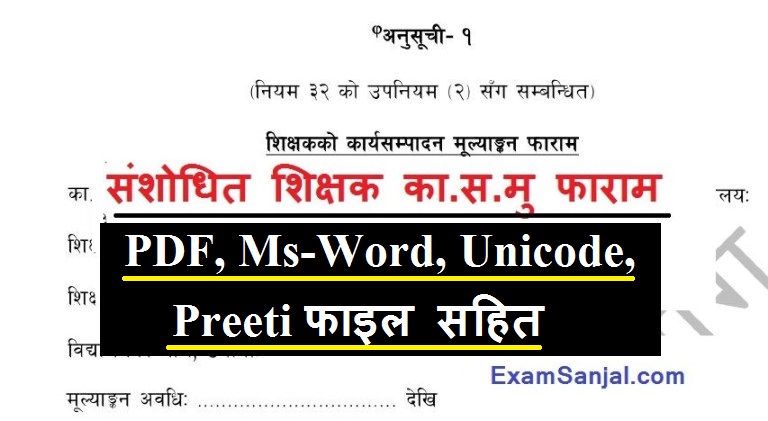
Teacher Kasamu Form download. Shikshak Karyasampadan mulyankan faram revised model. Teacher Ka Sa Mu Form. Teacher performance assessment form download view. Revised Shikshak Karyasampadan Mulyankan Faram ( Teacher Performance Assessment Form). Teacher Performance Assessment Form as amended by the Teachers Service Commission Rules 2057.
Click on the link below for PDF, Microsoft Word, Preeti & Unicode Format Ka Sa Mu Shikshak Form to download the revised Teacher Performance Assessment Form.
Nepal Teacher Performance Evaluation Form: Complete Guide for Primary, Lower Secondary & Secondary Levels Ka Sa Mu Form
In Nepal’s public education system, teacher accountability and professional development are measured through a structured Teacher Performance Evaluation Form — officially known as the “Shikshakko Karya Sampadan Mulyankan Pharam.” This form, governed under Anusuchi-1 (Schedule 1), Rule 32 of Nepal’s education regulations, serves as the official instrument for assessing every government school teacher’s job performance across three school levels:
- Primary Level (Prathamik Tah) — Classes 1–5
- Lower Secondary Level (Nimnamadhyamik Tah) — Classes 6–8
- Secondary Level (Madhyamik Tah) — Classes 9–12
This comprehensive guide explains the structure, scoring system, and evaluation process of all three forms in detail, helping teachers, school administrators, and education officials understand and use them effectively.
What Is the Teacher Ka Sa Mu Performance Evaluation Form in Nepal?
The Teacher Performance Evaluation Form (TPEF) is a legally mandated annual appraisal tool used by Nepal’s education authority to evaluate the professional performance of school teachers and headteachers. The form is color-coded by level:
| Level | Local Name (Romanized) | Color |
|---|---|---|
| Primary | Prathamik Tahaka Lagi | Blue |
| Lower Secondary | Nimnamadhyamik Tahaka Lagi | Green |
| Secondary | Madhyamik Tahaka Lagi | Yellow |
Despite the color difference, all three forms follow an identical structure with four major sections (Khand Ka, Kha, Ga, and Gha), ensuring uniformity in evaluation across all school levels.
Key Information Captured at the Top of the Form
Before the evaluation begins, the form collects essential identifying information:
- School name where the form is submitted
- Registration number and date
- Teacher/Headteacher’s full name
- Code number, level, and grade/class
- Current school name and address
- Evaluation period — from date to date
Section-by-Section Breakdown of the Evaluation Form
Khand Ka — Section A: Student Achievement in the Taught Subject
Total Marks: 3
This section evaluates the teacher’s effectiveness based on student exam results in the subject they teach. It includes the following sub-sections:
(A) Level Taught
The teacher specifies which school level they teach — Primary, Lower Secondary, or Secondary.
(B) Class Taught
The specific class or classes the teacher handles.
(C) Subject Taught
The subject(s) for which the teacher is being evaluated.
(D) Reference Examination Used
The form lists official national and standardized exams that serve as the benchmark for evaluation:
- Grade 3 Achievement Exam
- Grade 5 Achievement Exam
- Grade 8 Basic Level Completion Exam (SEE Grade 8)
- Grade 10 Secondary Education Exam (SEE)
- Grade 11 & 12 Higher Secondary Completion Exam
- Exam for Students with Disabilities
- Other (as applicable)
Teacher Ka Sa Mu Form Prabi Teacher Primary Teacher Karya Sampadan Mulyankan form
(E) Average Marks of Students in the Subject
The teacher records the average marks obtained by students in the relevant subject exam.
(F) Scoring Formula
The score for Section A is calculated using a ratio formula:
Teacher’s Score = (Class Average Pass Percentage in the Subject / Geographic Unit’s Average Pass Percentage in the Subject) x 3
This formula ensures that the evaluation is contextually fair — a teacher in a remote or disadvantaged area is evaluated relative to the average performance of their geographic unit, not a national standard. The maximum score here is 3 marks.
The teacher must sign and date this section to certify that the calculation is based on actual student exam results.
Khand Kha — Section B: Research Related to Teaching Work
Total Marks: 1
This section encourages teachers to engage in action research or classroom-based research to improve teaching quality. Teachers fill in:
- (A) Brief Description of the Research Topic
- (B) Brief Description of Research Findings
- (C) Number of Pages of Attached Report
The teacher receives up to 1 mark for completing relevant research and submitting a report. This section promotes a culture of reflective and evidence-based teaching.
Khand Ga — Section C: Details of Special Responsibilities
Total Marks: Variable
This section recognizes the additional administrative or leadership roles a teacher may carry within the school. Teachers indicate the roles they have held along with the time period (from-to dates):
| Role | Romanized Title |
|---|---|
| Headteacher | Pradhanaadhyapak |
| Assistant Headteacher | Sahayak Pradhanaadhyapak |
| Special Education Teacher | Vishesh Shiksha Shikshak |
| Class Teacher | Varga Shikshak |
| Multi-grade Teacher | Bahuvargiya Shikshak |
| Student Counseling & Advisory Coordinator | Vidyarthi Paramarsha Sewa Sanyojak |
| Music, Singing & Dance Coordinator | Sangit, Gayan ra Nritya Sanyojak |
| Sports Coordinator | Khelkud Sanyojak |
| Extra-Curricular Activities Coordinator | Atirikt Kriyakalap Sanyojak |
| Exam & Student Evaluation Coordinator | Pariksha ra Vidyarthi Mulyankan Sanyojak |
| School-Community Relations Coordinator | Vidyalaya Samuday Sambandha Sanyojak |
| Other | Anya |
Marks are awarded based on the nature and duration of the additional responsibility fulfilled.
Recommendation and Certification
Before moving to Section D, Sections A, B, and C must be formally recommended and certified by authorized officials. This requires:
- Signature, name, designation, code number, and date from both the recommender and certifier.
Teacher Ka Sa Mu Form Nimabi Teacher Lower Secondary Karya Sampadan Mulyankan form
Teacher Ka Sa Mu Form MaBi Teacher Secondary Karya Sampadan Mulyankan form
Khand Gha — Section D: Supervisor and Review Committee Evaluation
Total Marks: 10 (Supervisor: 6 + Review Committee: 4)
This is the most comprehensive section of the form, evaluating the teacher on 8 professional competency criteria by two separate bodies:
Evaluation Criteria:
| # | Criteria |
|---|---|
| 1 | Knowledge of Subject Matter |
| 2 | Dedication, diligence, and adherence to professional ethics |
| 3 | Responsiveness, accountability, and responsibility toward academic quality |
| 4 | Use of Teaching Methods and Skills |
| 5 | Punctuality, effective use of school/class time, and classroom management |
| 6 | Active participation in extracurricular activities |
| 7 | Collection, creation, and use of educational materials |
| 8 | Maintaining academic records of student progress and informing parents |
Scoring Scale:
Supervisor (Suparivekshak) — Maximum 6 Marks:
| Rating | Per Criterion Score |
|---|---|
| Excellent (Ati Uttam) | 0.75 |
| Good (Uttam) | 0.60 |
| Satisfactory (Samadhya) | 0.45 |
| Less (Nyun) | 0.30 |
=> View Download Print Teacher Kasamu Form All Level Teacher
Review Committee (Punaravalokana Samiti) — Maximum 4 Marks:
| Rating | Per Criterion Score |
|---|---|
| Excellent (Ati Uttam) | 0.50 |
| Good (Uttam) | 0.40 |
| Satisfactory (Samadhya) | 0.30 |
| Less (Nyun) | 0.20 |
The total marks from both bodies are summed to give a score out of 10, written both numerically and in words.
Supervisor’s Details Required:
- Name, Designation, Code Number, Signature, Date
Review Committee — 3 Members Required:
Each member provides their Name, Designation, Code Number, Signature, and Date.
Summary of Total Marks
| Section | Description | Maximum Marks |
|---|---|---|
| Section A (Khand Ka) | Student Achievement | 3 |
| Section B (Khand Kha) | Teaching-Related Research | 1 |
| Section C (Khand Ga) | Special Responsibilities | Variable |
| Section D (Khand Gha) | Supervisor Evaluation | 6 |
| Section D (Khand Gha) | Review Committee Evaluation | 4 |
| Grand Total | 14+ marks |
Differences Between the Three Level Forms
While the content and structure of all three forms are identical, they are distinguished by:
| Feature | Primary | Lower Secondary | Secondary |
|---|---|---|---|
| Background Color | Blue | Green | Yellow |
| Local Label | Prathamik Tahaka Lagi | Nimnamadhyamik Tahaka Lagi | Madhyamik Tahaka Lagi |
| Primary Exam Reference | Grade 3 & 5 Achievement Exam | Grade 8 Basic Level Exam | Grade 10, 11 & 12 Exams |
The color-coding helps officials and teachers quickly identify the appropriate form for their level.
Why Is This Evaluation Form Important?
1. Promotes Accountability
The form holds teachers accountable for student learning outcomes, linking their evaluation directly to measurable student performance data.
2. Encourages Professional Growth
By including sections on research and special responsibilities, the form encourages teachers to go beyond classroom instruction and contribute to broader school development.
3. Ensures Fair and Transparent Assessment
The dual-evaluator system — with a supervisor and a three-member review committee — minimizes bias and ensures a fair assessment process.
4. Supports Career Advancement
Performance evaluations are directly tied to teachers’ career progression, promotions, and increments in the Nepal education system.
5. Geographically Contextual Scoring
The formula used in Section A adjusts student achievement scores relative to the geographic unit’s average, ensuring that teachers in remote or disadvantaged areas are not unfairly penalized.
Who Uses This Form?
- Classroom Teachers — Fill in Sections A, B, and C based on their own performance
- Headteachers — Also complete the form as teacher-administrators
- School Supervisors — Evaluate teachers on the 8 criteria in Section D
- Review Committees — Three-member bodies that independently evaluate the same 8 criteria
- Education Offices — Collect, verify, and archive completed forms for administrative records
Tips for Teachers Filling Out the Form
- Collect exam data early — Gather your students’ subject-wise pass percentages before the evaluation period ends.
- Document your research — Even a small classroom-based action research qualifies for Section B marks. Keep a written report ready.
- Record all responsibilities — Note the exact dates (from-to) for every additional role you held during the evaluation period.
- Understand the scoring formula — Familiarize yourself with the geographic unit’s average pass percentage to understand your expected Section A score.
- Ensure signatures are complete — Missing signatures from the teacher, recommender, or certifier can invalidate the form.
=> View Download Print Teacher Kasamu Form All Level Teacher
Frequently Asked Questions (FAQs)
Q: Is the evaluation form the same for all three levels? A: Yes — the structure, sections, and scoring criteria are identical. Only the color and level label differ.
Q: What exam is used as the basis for Section A for a Grade 7 teacher? A: A Grade 7 teacher (Lower Secondary level) would reference the Grade 8 Basic Level Completion Exam as the closest standardized benchmark.
Q: How many marks can a teacher receive in total? A: The minimum guaranteed marks are 14 (3 + 1 + 6 + 4), plus additional marks from Section C based on special responsibilities held.
Q: Who signs the form to certify the student achievement data? A: The concerned teacher themselves must sign and date the Section A certification, confirming the calculation is based on actual exam results.
Q: Can a headteacher also receive marks for Section C? A: Yes. Headteachers are explicitly listed under Section C and receive marks corresponding to their administrative responsibility.
Conclusion
Nepal’s Teacher Performance Evaluation Form under Anusuchi-1, Niyam 32 is a well-structured, multi-dimensional appraisal tool that evaluates teachers across student outcomes, research engagement, additional responsibilities, and professional competencies. Covering all three school levels — Primary, Lower Secondary, and Secondary — the form ensures that every teacher in Nepal’s government school system is assessed consistently, fairly, and transparently.
Understanding this form thoroughly is essential for teachers seeking career advancement, school administrators managing evaluations, and education officials overseeing quality in Nepal’s public schooling sector.
2. Click Here for Ka Sa Mu Shikshak (MS Word) Preeti font.
3. Click Here for Ka Sa Mu Shikshak (Ms Word) Unicode
5. Click Here For All SEE Exam Model Questions With Answer
Revised Shikshak Karyasampadan Mulyankan Faram.Teacher Performance Assessment Form as amended by the Tenth Amendment (2076/06/13) of the Teachers Service Commission Rules 2057.