

Nepal is opening its doors wider to international investors by streamlining the entry process through a newly implemented Automatic Route for Foreign Direct Investment (FDI). Under the authority of the Foreign Investment and Technology Transfer Act, 2019 (Section 42, Subsection 1), the Government of Nepal has simplified the approval process for various industries to foster a more investor-friendly environment.
Whether you are looking into tech startups or large-scale infrastructure, here is everything you need to know about the geographic and sectoral opportunities available through this route.
No Limits on Growth
One of the most significant advantages of the Automatic Route is the flexibility it offers regarding capital. According to the latest government notifications, there is no maximum limit for foreign investment through this route. This allows investors to scale their operations according to market demand without facing restrictive ceilings.
High-Growth Sectors for Investment
The government has identified seven key sectors eligible for the Automatic Route:
Investing in Nepal in the field of IT Information Technology & AI Artificial Intelligence
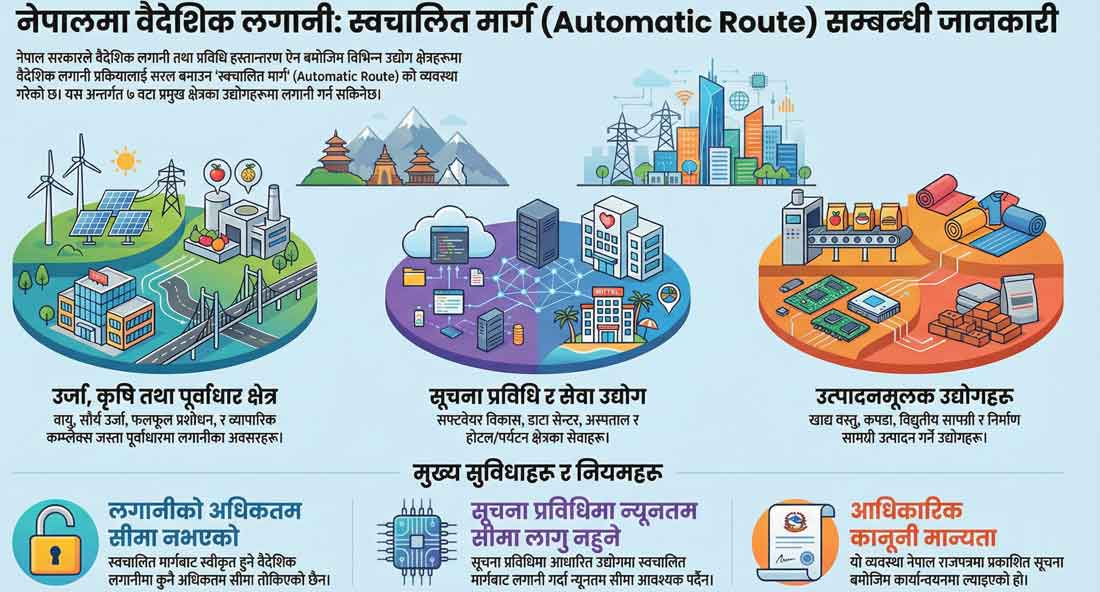
• Information Technology (IT): This is perhaps the most attractive sector for modern investors. It covers software development, Business Process Outsourcing (BPO), data centers, and cloud computing. Notably, for IT-based industries, there is no minimum investment limit required when applying through the automatic route.
The Automatic Route for foreign investment provides several significant advantages specifically tailored for IT startups in Nepal:
• Exemption from Minimum Investment Limits: One of the most critical benefits is that for IT-based industries, the minimum investment limit does not apply when seeking approval through the automatic route. This allows early-stage startups to secure foreign funding even if the amount is relatively small, which was previously a major barrier for many tech entrepreneurs.
• No Maximum Investment Ceiling: There is no upper limit on the amount of foreign investment that can be approved through this route. This allows successful startups to scale their operations and bring in larger rounds of funding without facing restrictive caps.
• Simplified and Faster Procedures: By moving to an “Automatic Route,” the government has streamlined the approval process, reducing the bureaucratic hurdles that often delay tech ventures. This speed is essential for the fast-moving IT sector.
• Comprehensive Sector Coverage: The policy covers a wide variety of IT niches, ensuring that most tech startups can qualify. Eligible areas include:
◦ Software Development and Data Processing.
◦ Business Process Outsourcing (BPO) and Knowledge Process Outsourcing (KPO).
◦ Data Centers, Data Mining, and Cloud Computing.
◦ Web Portals, Web Design, and Hosting Services.
◦ Technology and IT Parks.
This arrangement makes Nepal a more competitive destination for global tech investors and provides local startups with easier access to international capital and expertise
• Energy-Based Industries: Nepal’s natural resources offer vast potential. Investors can jump into solar, wind, and biomass energy production, as well as feasibility studies and the manufacturing of energy-related machinery.
• Tourism & Hospitality: As a premier global travel destination, Nepal allows automatic FDI in motels, hotels, resorts, and amusement parks. This also extends to “healing centers” and sports tourism.
• Manufacturing: A total of 41 diverse sub-sectors are open, ranging from electronics and textiles to the production of medicines, cement, and iron.
• Service Sector: Significant opportunities exist in healthcare, including hospitals and nursing homes, as well as logistics, waste management, and even professional services like advertising and mineral research.
• Infrastructure: Investment is encouraged in the construction and operation of convention centers, cargo complexes, film cities, and private warehouses.
• Agriculture and Forest-Based Industries: This includes processing units for tea, coffee, herbs, and fruits, as well as wood-based industries like furniture manufacturing.
Why Invest Now?
Summary of 41 Manufacturing Sectors Open for Automatic FDI in Nepal
Nepal has opened 41 diverse manufacturing sub-sectors for foreign investment through the streamlined Automatic Route. These can be broadly categorized into the following key areas to help investors identify opportunities:
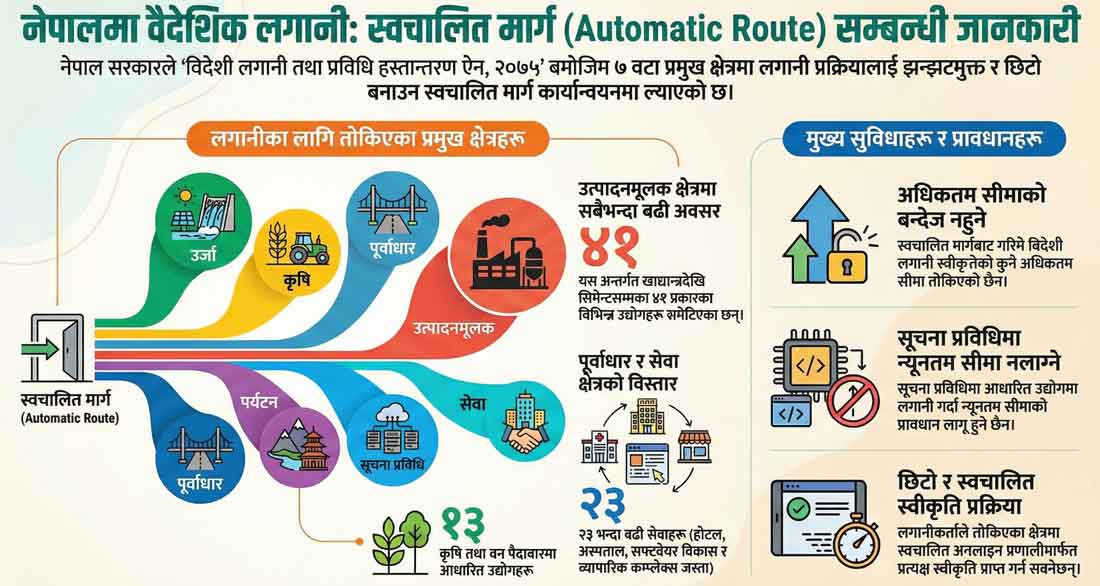
• Agro-Processing & Food Products: This is a major category including meat processing, animal feed, dairy-related mills (rice, oil, flour), sugar production (including Khadsari), bakery, confectionery, and processed snacks like noodles and tea. It also covers non-alcoholic beverages and water processing.
• Construction Materials & Heavy Industry: High-demand sectors like cement, iron rods, zinc sheets, bricks, tiles, and bitumen are all open. It also includes fabrication materials, paints, and lubricants.
• Electronics & Electrical Engineering: Opportunities exist in manufacturing household appliances, electric wires and cables, batteries, and electrical fittings like switches and meters.
• Textiles & Lifestyle Goods: This covers textiles, readymade garments, and the manufacturing of bags, suitcases, and travel gear. Furniture, plywood, and non-traditional wood products also fall under this category.
• Chemicals & Personal Care: Production of essential items like soap, shampoo, toothpaste, and other toiletries is included, alongside chemical and organic fertilizers.
• Healthcare & Stationery: The route allows for the manufacturing of medical, surgical, and orthopedic equipment, as well as paper, pulp, and stationery products.
• Automotive & Plastic/Rubber: Manufacturing of cycles, scooters, motorcycles, and motor vehicles, including their parts, is open. This also extends to tires, tubes, and various plastic and rubber-based products.
• Miscellaneous Manufacturing: Other industries include glassware, matches, candles, and incense sticks.
Key Takeaway for Investors: Investments in these manufacturing sectors through the automatic route enjoy no maximum investment ceiling, providing a clear path for large-scale industrial operations in Nepal.
The move to an Automatic Route represents a shift toward digital governance and transparency. By removing traditional bureaucratic hurdles and, in the case of IT, eliminating the minimum entry barrier, Nepal is positioning itself as a competitive hub for regional business.
Conclusion
For global investors looking to tap into a growing market with a simplified entry process, Nepal’s Automatic Route provides a clear and efficient pathway. With diverse sectors ranging from high-tech data mining to sustainable energy, the landscape is ripe for strategic investment
=> Read Download Full Page Foreign Investment in Nepal New Policy