
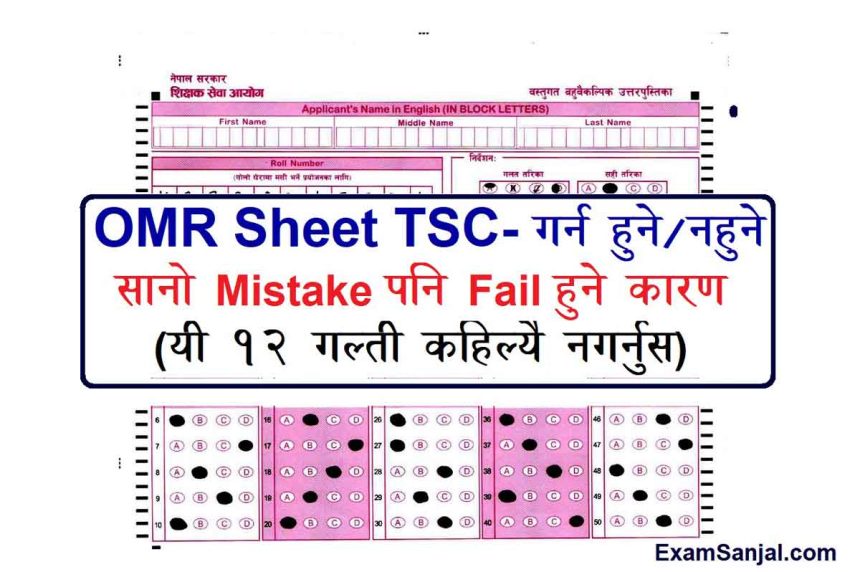
The Teacher Service Commission (TSC) OMR Sheet TSC Download Print is a critical component of the teacher licensing and recruitment examination in Nepal. Understanding how to properly fill out your OMR answer sheet can make the difference between success and failure in your TSC exam. This comprehensive guide covers everything you need to know about TSC OMR sheets, from downloading sample sheets to avoiding common mistakes.
What is an OMR Sheet TSC?
An OMR (Optical Mark Recognition) Sheet is an answer sheet used by the Teacher Service Commission for evaluating candidates’ responses in teaching license examinations and teacher recruitment tests. The sheet uses optical scanning technology to automatically read and grade candidates’ answers, making the evaluation process faster and more accurate.
The TSC conducts examinations for various teaching levels including Primary Level (Pra.Vi.), Lower Secondary Level (NiMaVi), and Secondary Level (MaVi) positions across Nepal. All these examinations utilize OMR sheets for the objective multiple-choice question sections.
Why is the OMR Sheet TSC Important?
The OMR sheet is not just an answer sheet—it’s your gateway to a teaching career in Nepal’s government schools. Even if you know all the correct answers, improper filling of the OMR sheet can lead to:
- Incorrect evaluation of your answers
- Loss of marks or complete disqualification
- Automatic cancellation of your examination
- Rejection of your answer sheet by the scanning machine
The optical mark reader only recognizes properly darkened circles. Any deviation from the standard marking pattern may result in your answers not being detected at all.
TSC OMR Sheet Download: How to Get Sample Sheets
Practicing with sample OMR sheets before your actual examination is crucial for building confidence and accuracy. Here’s how you can download TSC OMR sheets:

Sample OMR Sheet TSC for Different Levels
Download these sample sheets, print them, and practice filling them out multiple times before your exam day.

Essential Materials for Filling TSC OMR Sheet
Before you begin filling your OMR sheet, ensure you have the correct materials:
What to Use:
- Black ballpoint pen only: This is mandatory and strictly enforced
- The ink should be dark enough to be detected by the optical scanner
- Medium tip pens work best for filling circles completely
What NOT to Use:
- Pencils (strictly prohibited)
- Gel pens
- Fountain pens
- Blue or colored pens
- Erasers (marks cannot be erased)

=> View Download Print OMR Sheet Sample
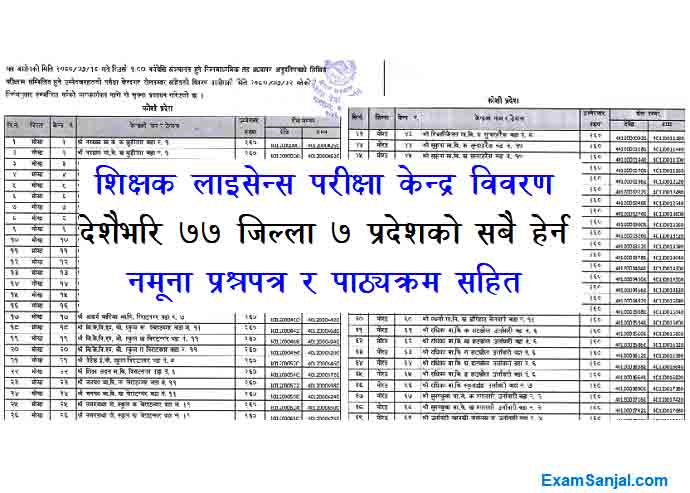
Using the wrong writing instrument can lead to disqualification from the examination.
Step-by-Step Guide: How to Fill TSC OMR Sheet Correctly
Step 1: Personal Information Section
Roll Number
- Write your roll number exactly as printed on your admit card
- Do not make any changes or corrections to the roll number
- Fill the corresponding circles below each digit of your roll number
- Each number (0-9) has its own circle—darken only the correct one
Candidate Name
- Write your name in BLOCK LETTERS (capital letters)
- Fill one letter per box
- Darken the corresponding circle below each letter
- Ensure accuracy as this information is used for identification
Advertisement Number
- Write the advertisement number as mentioned in your exam notice
- For example: 38/078/079 for specific recruitment drives
- Fill the circles below each digit carefully
Level and Subject
- Write your examination level (Primary/Lower Secondary/Secondary)
- Mention your main subject clearly
- Fill the corresponding circles
Question Set
- Your question paper will have Set A, B, C, or D printed on top
- Mark the circle corresponding to your question set
- This is crucial as answer keys vary by set
Examination Type
- Mark whether you’re appearing for Teaching License or other examination types
- Fill the appropriate circle
Step 2: Filling Answer Bubbles
General Rules:
- Mark only ONE circle per question
- Fill the circle completely and darkly
- Stay within the circle boundaries
- Do not make any stray marks on the sheet
Correct Marking Technique:
- Use firm, consistent pressure
- Fill the entire circle, not just a dot or tick mark
- The mark should be dark enough for the scanner to detect
- All marked circles should have uniform darkness
=> Download Print OMR Sheet TSC Exam Sample OMR for Practice
What NOT to Do:
- Do not tick or cross mark the answers
- Do not fill multiple circles for the same question
- Do not make partial or light marks
- Avoid making any marks outside the designated circles
Step 3: Review Before Submission
- Double-check your roll number and personal details
- Verify that you’ve marked the correct question set
- Ensure all intended answers are properly filled
- Check for any stray marks or incomplete circles
- Confirm your signature is in the designated area
Common Mistakes to Avoid with TSC OMR Sheets
Critical Errors:
- Using the Wrong Pen: Using pencil, gel pen, or blue pen instead of black ballpoint pen
- Multiple Markings: Filling more than one circle for a single question
- Incomplete Circles: Making light or partial marks that the scanner cannot detect
- Wrong Question Set: Marking a different question set than what you received
- Incorrect Roll Number: Writing or marking the wrong roll number
- Folding or Damaging: Creasing, tearing, or staining the OMR sheet
- Overwriting: Attempting to change answers by overwriting (this invalidates the answer)
Minor Mistakes That Still Matter:
- Making stray marks outside answer circles
- Inconsistent pressure causing uneven darkness
- Not filling circles completely to the edges
- Leaving smudges or fingerprints on the sheet
- Writing in areas not designated for writing
TSC OMR Sheet Guidelines: Do’s and Don’ts
DO’s:
✓ Use only a black ballpoint pen ✓ Keep the OMR sheet clean, flat, and undamaged ✓ Fill circles completely and uniformly ✓ Mark your roll number carefully ✓ Verify your question set before answering ✓ Fill personal information before the exam begins ✓ Mark answers directly during the exam ✓ Double-check all information before submission ✓ Practice with sample OMR sheets beforehand ✓ Handle the sheet carefully throughout the exam
DON’Ts:
✗ Don’t use pencils, erasers, or correction fluid ✗ Don’t fold, wrinkle, or tear the OMR sheet ✗ Don’t make stray marks anywhere on the sheet ✗ Don’t mark multiple answers for one question ✗ Don’t write outside designated areas ✗ Don’t exchange your OMR sheet (only one is provided) ✗ Don’t mark answers lightly or incompletely ✗ Don’t forget to mark the question set ✗ Don’t submit without final verification ✗ Don’t panic—stay calm and focused
Time Management Tips for TSC OMR Sheet
Before the Exam:
- Arrive early to reduce stress
- Bring multiple black ballpoint pens
- Practice filling sample OMR sheets at home
- Understand the exam pattern and marking scheme
During the Exam:
- Read instructions on the OMR sheet carefully
- Fill personal details first (before questions start)
- Answer questions you’re confident about first
- Mark answers directly on OMR sheet rather than question paper
- Keep track of time for both answering and marking
- Reserve 10-15 minutes for final review
Final Minutes:
- Verify all personal information is correct
- Check that all intended answers are marked
- Ensure no questions are accidentally left blank
- Look for any stray marks to avoid
- Confirm your signature is in place
Understanding OMR Technology for TSC Exams
The Teacher Service Commission uses advanced OMR technology to evaluate thousands of answer sheets quickly and accurately. Here’s how it works:
Scanning Process:
- OMR sheets are fed through optical mark readers
- The machine detects the darkness of marks in circles
- Only properly filled circles register as answers
- The system compares your marks against the correct answer key
- Scores are calculated automatically
Why Proper Filling Matters:
- The scanner cannot read pencil marks or light ink
- Multiple marks confuse the machine
- Stray marks may be counted as wrong answers
- Damaged sheets may not scan properly
- Inconsistent marking can lead to detection errors
Practice Makes Perfect: Using Sample OMR Sheets
To excel in your TSC examination, regular practice with sample OMR sheets is essential:
Practice Strategy:
- Download Official Samples: Get authentic OMR sheets from TSC website
- Print Multiple Copies: Practice with at least 10-15 sample sheets
- Time Yourself: Fill sheets within exam time constraints
- Check Your Technique: Ensure all marks are uniform and complete
- Simulate Exam Conditions: Practice in a quiet environment
- Review Your Work: Check for common mistakes after each practice
- Improve Gradually: Work on speed and accuracy together
Benefits of Practice:
- Builds familiarity with the OMR format
- Reduces exam day anxiety
- Improves marking speed and accuracy
- Helps identify personal tendencies for mistakes
- Increases confidence in the examination
TSC OMR Sheet FAQs
Q: Can I change my answer on the OMR sheet? A: No, once you mark an answer, it cannot be changed. Overwriting or attempting to erase will invalidate your answer. Think carefully before marking.
Q: What if I accidentally mark the wrong circle? A: Unfortunately, there’s no way to correct it. This is why careful attention and review are crucial before marking each answer.
Q: How many OMR sheets will I receive? A: You will receive only ONE OMR sheet. There are no replacements, so handle it with extreme care.
Q: What happens if my OMR sheet is damaged during the exam? A: A damaged OMR sheet may not scan properly or may be rejected. Keep your sheet flat and clean throughout the examination.
Q: Can I mark answers on the question paper first and transfer later? A: While possible, this wastes valuable time and increases error risk. Mark answers directly on the OMR sheet during the exam.
Q: What if I don’t mark the question set correctly? A: Your entire answer sheet may be evaluated against the wrong answer key, resulting in incorrect scoring or complete failure.
Q: Is there negative marking in TSC examinations? A: Check your specific examination notice for marking scheme details. Negative marking policies can vary by examination type.
Q: Where can I find the official TSC OMR sheet format? A: Visit the official TSC website at tsc.gov.np or check the downloads section for authentic sample sheets.
Final Checklist for TSC OMR Sheet Success
Before Your Exam:
- Downloaded and practiced with sample OMR sheets
- Purchased good quality black ballpoint pens (carry 2-3 pens)
- Reviewed the OMR filling guidelines thoroughly
- Checked your admit card for correct roll number
- Noted your question set information
During Your Exam:
- Received your OMR sheet in good condition
- Verified all personal details are filled correctly
- Marked the correct question set
- Filled roll number accurately
- Used only black ballpoint pen
- Kept the sheet clean and undamaged
- Marked all answers clearly and completely
Before Submission:
- Reviewed all personal information
- Checked that all answers are properly marked
- Ensured no stray marks exist
- Verified question set is correct
- Confirmed signature is in place
- Sheet is clean and undamaged
Conclusion
The TSC OMR Sheet is your primary tool for demonstrating your knowledge in the Teacher Service Commission examination. While the content you study is important, your ability to correctly transfer that knowledge onto the OMR sheet is equally crucial. A single mistake in filling the OMR sheet can cost you marks or even your entire examination.
Success in TSC examinations requires both subject knowledge and technical proficiency in OMR sheet handling. Download sample OMR sheets from the official TSC website, practice filling them regularly, and familiarize yourself with all the guidelines mentioned in this guide.
Remember: even if you know every answer, improper OMR sheet filling can lead to failure. Take the time to practice, follow all instructions carefully, and approach your examination day with confidence. Your teaching career in Nepal’s government schools begins with a properly filled OMR sheet.
Best of luck with your TSC examination! With proper preparation and careful attention to OMR sheet guidelines, you’re one step closer to achieving your dream of becoming a licensed teacher in Nepal.